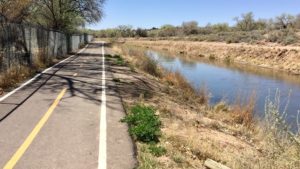
 A jogger trots along the River Loop Trail shielded by the shade of shimmering cottonwoods. A peloton blasts down a paved road along the Rio Grande, decked out in day glow spandex. An older lady sits at a bench on the riverbanks, meditating on the lazily moving river. A classroom of hyperactive eight-year-olds run through the fascinating exhibits at the Visitor Center, amazingly absorbing a good 30-33% of what is being explained at every station. These are some of the many scenes you will encounter at the Rio Grande Nature Center State Park, a wonderful destination-point for people of all ages and interests, and homage to the Southwest’s staff of life, the Rio Grande.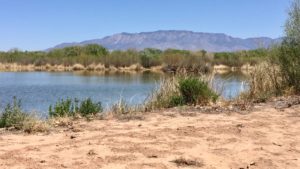
Located in Albuquerque’s North Valley on Candelaria and Rio Grande Blvd the Rio Grande Nature Center is part of a bosque, or cottonwood forest by the wetland bordering the river. It boasts some 270 acres of woods, meadows and farmland with native grasses, wildflowers, willows and of course, cottonwoods. The park’s hub consists of the Visitor Center which was designed by Albuquerque native-architect Antoine Predock, and contains many exhibits on the area’s riparian environment.
And the flora and fauna do not disappoint. The animals provide the eye candy, with a huge range of species: everything from toads to beavers and great horned owls to woodpeckers. When I stopped by the Visitor Center I had the pleasure of watching a family of turtles from the comfortable air conditioned Predock-designed Observation Room.
 If meditating on a slow-moving group of turtles (also known as a “bale”) isn’t your speed there are many other active ways at the Nature Center to enjoy the Rio Grande. The Riverwalk Trail and Bosque Loop Trail provide one-mile and 0.8 mile hikes, respectively through open meadows, heavily wooded areas and along the river. The paved road along the Rio Grande provides the perfect bicycle superhighway for those who want to go real fast.
The Nature Center realizes the vital role that the Rio Grande plays in the Southwest’s ecosystem. Since it is the fourth longest river system in North America, measuring some 1,248 miles long, it makes sense that Albuquerque holds it in such grande regard. My own video Sutter Sugar of The Sugar Team is my own tribute to the Rio Grande Nature Center and the Rio Grande, yet another example why I live to live here in Albuquerque!:
 The most educational and culturally rich area in all of Albuquerque is densely concentrated in a three-block universe in historic Old Town. Museum Row lines up the most powerful think-tanks, one right after the other:
 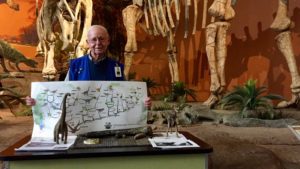 stationed at each one of the key stations. In the atrium a retired physicist was situated in front of the massive dinosaur skeletons, cheerfully explaining the lineage and evolutionary process of the gargantuan reptiles. Thanks to the docents, you don’t have to read all the placards (thank God!), and because of the insight of one docent, I learned that the modern lungfish is a key evolutionary animal that still exists today.
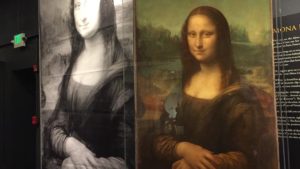 Without creating too much of a sense of urgency, it is crucial that everyone visit the temporary exhibit “The Genius, Leonardo Da Vinci” immediately and before it moves to its next location after July 29, 2018. This scintillating exhibition consists of two parts. The first focuses on his paintings, and of course the world’s most famous one “la Giocanda,” the laughing one, or Mona Lisa. In it you will find copious explanations of that famous elusive smile, the shadowy quality of the work and of course, its historic context. There’s even a replica of the back of the painting (spoiler alert…it’s made of wood!)!
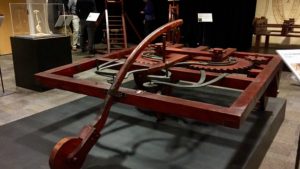 inventions, all brought to life by modern day artisans from his detailed journals. You will find everything from real-life concepts of a car to a military tank. What sets this delightful exhibit from any other one I’ve experienced that it is almost all hands-on! Nothing is more joyful than watching a young boy pull a lever that forces a hammer to slam down on an anvil, or watch a young girl be surprised by pulling a lever that moves a gear, that operates another gear, and so on and so on…, all of which were originally designed by a brilliant mind who lived some 500 years ago.
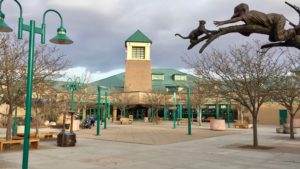 A young couple nervously recites their wedding vows under a gorgeous arbor bathed in lavender colored wisteria flowers. A toddler climbs over a large plastic carrot three times his size. Two young girls pop their head into a plastic dome crawling with humongous cockroaches and other hideous, slithering insects. Is this another playful–often creepy–Tim Burton movie? No, rather a moment of time at the ABQ BioPark Botanic Garden: a delightful combination of color, exploration, tranquility and romance.
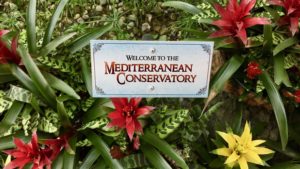 After you have gotten your “love on” (yeah, baby!) no visit to the Botanic Garden is complete without a visit to the Conservatory. A 10,000 square foot glass pyramid housing the Mediterranean exhibit in one wing and the Desert exhibit in the other, the Conservatory is considered the epicenter of the Garden. The Mediterranean Conservatory displays flora native to coastal areas with hot, dry summers and mild, rainy winters like in the Mediterranean Sea coast, the California coast, southwestern Australia, South Africa and coastal Chile. In this colorful wing you will find rockroses, bottlebrush trees, olive trees and mints/sages to name a few. On the other hand (wing), the Desert Conservatory showcases desert plants that flourish and bloom year-round in hot, dry climates, including the saguaro cactus, palo verdes, yucca and everything xeric.
 Not to slight the kids (or the kids-at-heart in all of us!) we have to give the Children’s Fantasy Garden its due. Without giving too much away, this garden is an intensely creative labyrinth guarded by a fourteen-foot high topiary dragon. The fun is in the exploration, and there is everything from a walk-through 42-foot wide pumpkin, comically large vegetables (are they “juiced”?) and REALLY BIG BUGS.
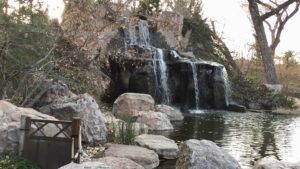 mazes the rest of us adults can relax or even meditate while enjoying the Sasebo Japanese Garden. This peaceful four-acre compound was crafted to honor Albuquerque’s Japanese sister city Sasebo. It hosts a waterfall, koi pond, stone lanterns, pagoda sculptures, wooden bridges and a mix of local and Japanese plants. There really is nothing more tranquil than meandering through the gardens and meditating.
 homage to the insect. Not for the squeamish, you will have the opportunity to check out giant tarantulas, leaf cutter ants, nocturnal scorpions, naked mole rats and other amazing arthropods that are practically invisible because they camouflage themselves so well (what’s that on your shoulder?!).
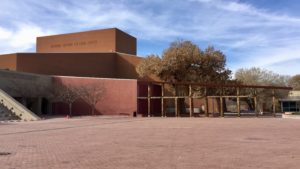 Enjoy this fun and insightful little video about Albuquerque’s cultural icon, the National Hispanic Cultural Center!
 Please enjoy this presentation of The Pit, Albuquerque’s premium venue for the Lobos of University of New Mexico!
 On Albuquerque’s Museum Row we have the privilege of enjoying Explora! Albuquerque’s science museum designed to appeal to scientists (or budding scientists!) of all ages. Please enjoy our little presentation that touches upon some of
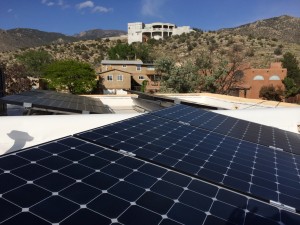
 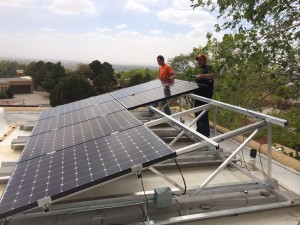 received an energy audit and had numerous evaluations by engineers, and it was determined we would need 30 photovoltaic solar panels or a 9.81 kWh (kilowatt hour) solar system to offset our energy use through the course of the year.
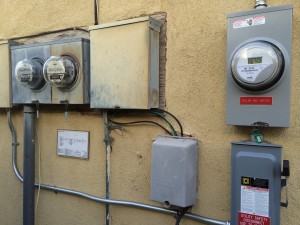 There is nothing more satisfying than watching your electric meter move in reverse. Living here in the Sunbelt where according to the Current Results Website we average 278 sunny days in Albuquerque, it’s no surprise to see a meter connected to a solar system spinning backwards. And because I entered into an eight-year contract with my electric company, their buy-back rate is guaranteed during that period. Of course, there is speculation the rate will go down, but no one knows for sure.
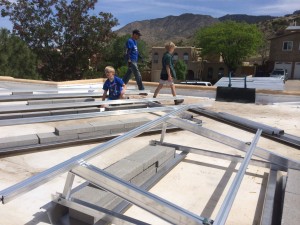 The installation itself only took five days. We have a flat roof so we decided to get a “ballast system.” This is where the frames that sustain the panels are held in place by cinder blocks (rather than bolted in) and are designed to withstand winds up to 120 miles per hour. The result is a gorgeous design with 30 photovoltaic panels feeding into two inverters that convert solar energy into alternative current (AC). This converted energy leads to the Renewable Energy Credit (REC) Meter that, of course ultimately ties into the electric company’s meter.